Resource Guide · Accessible Portable Restrooms
ADA Portable Toilet Rental
A practical guide to renting accessible portable restrooms for job sites, outdoor events, festivals, and construction projects. Covers unit features, planning considerations, placement, and questions to ask your provider.
Get Free Quotes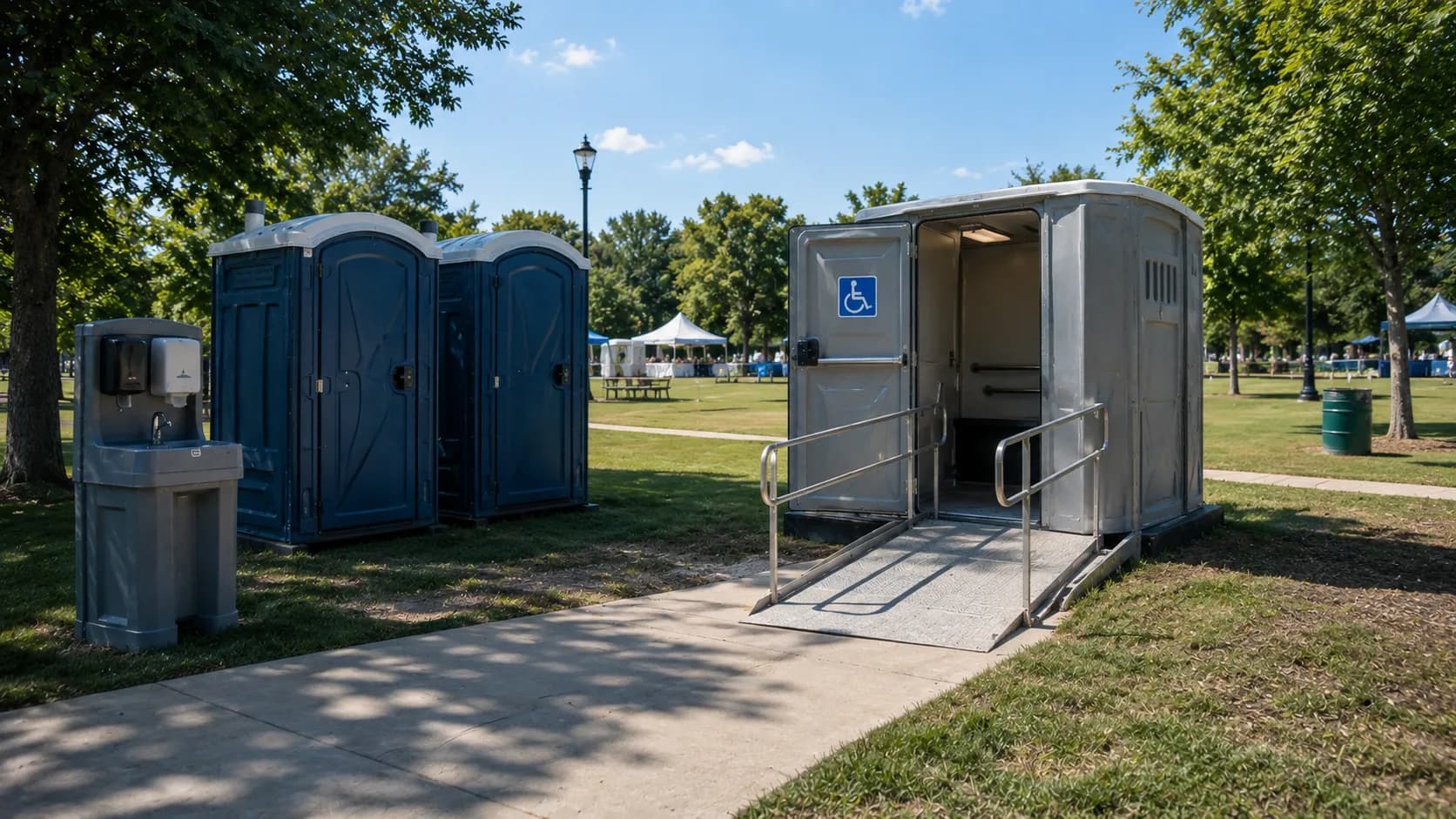
Quick Answer
What is an ADA portable toilet?
An ADA portable toilet is an accessible portable restroom designed to accommodate wheelchair users and people with mobility limitations. These units are larger than standard units and typically include a wide outward-swinging door, grab bars on both sides, and enough interior space for a wheelchair to turn.
Accessible portable restrooms are commonly expected or required at public events, permitted construction sites, and other regulated locations — though specific requirements vary by event type, venue, local ordinance, and the authority having jurisdiction. Your provider, venue, or local permitting office can confirm what applies to your situation.
On this page
What to Look for in an ADA Portable Toilet
Accessible portable restrooms are generally built to align with ADA Standards for Accessible Design. When evaluating a unit, these are the features commonly associated with ADA-accessible models:
| Feature | Common ADA Specification |
|---|---|
| Interior turning radius | 60 inches (enough space for a wheelchair to turn) |
| Door clear width | 32 inches or wider (36 inches preferred) |
| Door swing | Outward — does not swing into usable interior space |
| Seat height | Typically 17–19 inches from floor |
| Grab bars | Both sides of the toilet, mounted at an accessible height |
| Interior dimensions | Typically around 60" × 60" (5 ft × 5 ft) |
| Floor surface | Stable, firm, and slip-resistant |
| Accessible path to unit | Firm, stable surface from pedestrian area to door |
For reference, a standard portable toilet has an interior of roughly 38 inches × 38 inches — not wide enough to accommodate a wheelchair or provide a 60-inch turning radius. That's why ADA units are larger, typically cost more, and may be in shorter supply in some markets.
Note: Specifications vary by manufacturer and product line. Always confirm that the specific unit being quoted meets your needs before booking.
ADA Portable Toilet Rental Cost
ADA portable toilet rentals typically cost more than standard units. Pricing varies based on your region, the provider, rental duration, number of units ordered, and whether service visits are included in the quoted rate.
Standard portable toilet
Lower base rate
Common in most rental fleets; weekly service typically included
ADA portable toilet
Higher base rate
Premium reflects larger footprint, specialized hardware, and lower fleet availability
Most providers include one weekly pump-out and restocking in the quoted rate. High-traffic events may need additional service visits, which are typically billed separately. Pricing differences between markets can be significant — request quotes from local providers to get accurate numbers for your area.
If your project needs both standard and ADA units, bundling them in a single quote request often results in better per-unit pricing.
How Many ADA Units Do You Need?
The number of accessible units you may need depends on event size, event type, site layout, local ordinances, and requirements from the authority having jurisdiction. There is no single universal formula — what's expected at a county fair permit differs from what's needed on a private job site.
Planning starting points
- Many planners include at least one accessible unit in any deployment, regardless of total unit count
- Larger deployments often scale accessible unit counts proportionally as total units increase
- Event permits may specify accessible unit counts — confirm with your local permitting office before finalizing
- Some venues and municipalities have their own accessibility standards that go beyond general guidelines
- Your portable toilet provider can help you think through appropriate coverage for your specific project
When in doubt, erring on the side of more accessible coverage is generally the safer call — for your guests or workers, and for the permitting process. Your provider, venue coordinator, or local permitting office can help you determine what makes sense for your specific situation.
Placement and Accessibility Considerations
An accessible unit placed on uneven ground or blocked by obstacles may be difficult or impossible to use regardless of its specifications. Placement is just as important as the unit itself.
Level ground
The unit should sit on ground that is as level as possible. Even a modest tilt can reduce the usable interior space and make maneuvering difficult for wheelchair users.
Accessible path of travel
The path from the main pedestrian area to the ADA unit door should be firm and stable. Soft mud, loose gravel, or uneven terrain can make the unit effectively inaccessible even if it meets all unit specifications.
Door clearance
Clear space in front of the unit door is needed for approach and maneuvering. Avoid placing ADA units in corners or against fences where the door cannot fully open.
Proximity to standard units
Placing ADA units near the main restroom area — but visible and clearly accessible — helps users locate them without having to search.
ADA Units on Construction Sites
OSHA's sanitation standards (29 CFR 1926.51) address portable restroom counts based on crew size, but accessibility requirements for temporary construction facilities can vary depending on site conditions, who has access to the site, and local permit requirements.
Three common situations where an ADA unit is often expected or may be needed on a job site:
- 1
Public or client access to the site
If clients, homeowners, or members of the public have access to the site during work, accessible facilities may be expected or required. Check with your local building department or permitting authority for guidance.
- 2
Workers who may need accessible facilities
If a worker needs an accessible restroom, providing one is generally good practice and may be legally required depending on the employment situation. Consult HR or legal counsel with questions about accommodation obligations.
- 3
Local permit conditions
Some municipalities address accessible facilities as a condition of the construction permit. Review your permit requirements and check with your local building department — OSHA compliance alone may not be the full picture.
ADA Units for Events and Festivals
Accessible portable restrooms are commonly expected at public events — festivals, fairs, concerts, outdoor weddings, farmers markets, and similar gatherings. The specific count depends on event size, venue, the issuing permitting authority, and any local ordinances that apply.
Many permitting offices ask about accessible facilities as part of the sanitation plan review. Confirm the requirements with your local authority before finalizing your unit count — it's easier to plan for it upfront than to revise after submission.
Event planning checklist for ADA restrooms
- Estimate total unit count based on expected attendance and event duration
- Contact your local permitting office or event venue to confirm accessible unit requirements
- Factor accessible units into your initial sanitation plan — not as an afterthought
- Confirm placement on firm, level ground with a clear path from the main pedestrian area
- Verify that door clearance allows full approach and maneuvering
- Include ADA restroom location in event maps or signage so guests can find them
- Book accessible units early — they're in shorter supply in most markets
Questions to Ask Your Rental Provider
Not every unit marketed as “ADA” or “accessible” has the same specifications. Before confirming a rental, ask:
What are the interior dimensions of your ADA unit?
Look for enough interior space for wheelchair maneuvering — typically around 60" × 60". Ask if you have specific size requirements.
Does the door swing outward?
Outward-swinging doors are standard on accessible units. Inward-swinging doors reduce usable interior space.
What is the door clear width?
Wider doors accommodate more types of mobility equipment. Ask for the exact measurement if door width matters for your situation.
Do you provide a portable ramp if the surface isn't level?
Some providers include ramps. Others charge extra or don't offer them. Confirm options before booking if your site has uneven ground.
Is weekly service included in the quoted rate?
Most quotes include one pump-out and restock per week. High-traffic events often need additional visits — confirm what is and isn't included.
How far in advance do I need to book?
ADA units are in shorter supply than standard units in most rental fleets. Ask early so you're not scrambling close to your event date.
Related Resources
More guides on portable restroom rentals.
ADA Portable Toilet Rental FAQ
Need an ADA portable toilet for your project?
Tell us where your job site, event, or project is located and we'll help match you with providers who have accessible units available in your area.
Get Free Quotes