
Resource Guide · OSHA Compliance
OSHA Porta Potty Requirements in Colorado
A practical guide to federal OSHA sanitation requirements for Colorado construction sites. Covers the unit count standard (29 CFR 1926.51), service and maintenance requirements, and how local permit conditions can add to the federal baseline.
Get Free Quotes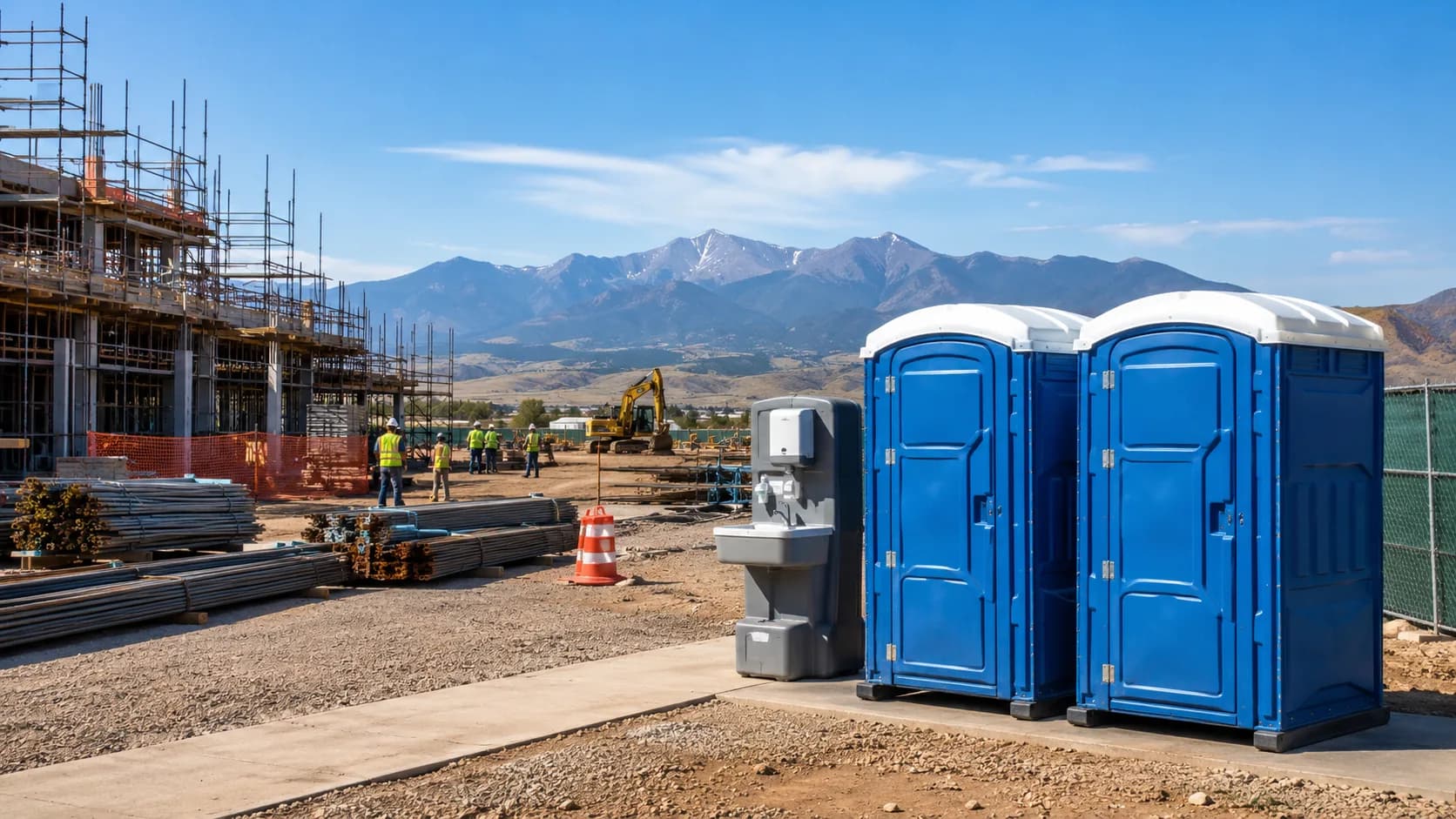
Quick Answer
OSHA's baseline for Colorado construction
Federal OSHA (29 CFR 1926.51) requires at least 1 toilet per 20 workers when permanent facilities aren't reasonably accessible. Federal OSHA covers private sector construction in Colorado — the state does not have its own OSHA state plan for private employers.
The OSHA count is a legal minimum. Local building permits, project specifications, and general contractor requirements may set higher counts. Always verify with your local building department when pulling permits.
On this page
OSHA 29 CFR 1926.51 Explained
The controlling federal standard for construction sanitation is 29 CFR 1926.51 — Sanitation, published by the Occupational Safety and Health Administration. It covers toilet facilities, potable water, handwashing, and general sanitation for construction sites.
The standard applies when workers do not have access to toilet facilities in a permanent structure that is reasonably accessible during the workday. On most open-site construction projects — ground-up builds, infrastructure projects, road work, land development — portable toilets are the standard solution.
Key requirements at a glance
- Toilet facilities must be provided for all construction employees
- Minimum counts are set by crew size (see table below)
- Units must be maintained in a sanitary condition
- Handwashing facilities with clean water, soap, and drying materials are required
- Potable drinking water must be provided separately from toilet facilities
- Toilets must be accessible — not blocked by equipment or materials
Required Unit Counts by Crew Size
OSHA's unit count requirement scales with the number of workers on site. These are legal minimums — not recommendations. Your local building permit or general contractor requirements may be higher.
| Workers on Site | Toilets Required | Urinals Required | Notes |
|---|---|---|---|
| 1–20 | 1 toilet | — | Minimum baseline; applies when permanent facilities are not reasonably accessible |
| 21–200 | 1 toilet per 40 | 1 urinal per 40 | Both required; round up for partial groups |
| 200+ | 1 toilet per 50 | 1 urinal per 50 | Higher ratio required; local permits may require more |
Source: 29 CFR 1926.51(c)(1). Crew count refers to the maximum number of workers present on site at one time, not total project headcount.
Sanitation and Maintenance Standards
Providing enough units is only part of the requirement. OSHA also specifies how those facilities must be maintained and what supporting sanitation infrastructure is required on site.
Sanitary condition
Units must be maintained in a sanitary condition throughout the project. This includes regular pump-outs and restocking of supplies.
Handwashing facilities
Washing facilities with clean water, soap, and individual towels or air-drying equipment are required. Standalone hand wash stations alongside porta potties typically satisfy this requirement.
Potable drinking water
Separate from toilet facilities — OSHA requires potable water for drinking and personal sanitation on all construction sites.
Privacy and security
Toilet facilities must provide privacy. Units should be secured so they can be used privately and safely.
Not used for storage
OSHA prohibits using toilet facilities as storage areas for tools, materials, or equipment.
Service intervals and what's typically included
Most construction rental contracts include one weekly pump-out and restock as the standard service interval. For crews of 20 or fewer, this typically satisfies OSHA's sanitation maintenance requirement. Larger crews or sites with heavy use may need twice-weekly or even more frequent service. Your provider can help assess the right schedule — ask what's included and what additional visits cost.
Colorado-Specific Context
Understanding which set of rules governs your Colorado construction site is important before you start ordering units.
Federal OSHA covers private sector construction in Colorado
Colorado does not have an OSHA state plan for private sector employers. Federal OSHA (29 CFR 1926) governs private construction workers in Colorado directly. OSHA compliance officers from the U.S. Department of Labor conduct inspections and issue citations for violations.
Colorado OSHA (COSH) covers public sector workers
The Colorado Division of Labor Standards and Statistics operates a state safety program for state and local government employees (public sector). If your project involves workers employed by a Colorado government entity, COSH requirements apply. For most private commercial and residential construction, federal OSHA is the governing authority.
Local municipalities may add requirements
Denver, Colorado Springs, Fort Collins, and other municipalities issue their own building permits, and permit conditions can specify sanitation requirements above the federal OSHA baseline. Front Range municipalities with active development have well-developed inspection programs. Always confirm permit conditions with your local building department when pulling permits for your project.
Mountain and remote site considerations
Construction projects at high elevation, in mountain communities, or on remote sites often face additional logistical constraints around portable toilet service — longer delivery routes, seasonal road access issues, and fewer local providers. This doesn't change the OSHA requirement, but it can affect your ability to maintain the required service frequency. Plan service schedules with your provider well in advance for remote or seasonal sites.
Local Permit Requirements in Colorado
OSHA sets the federal floor. Local jurisdictions can — and sometimes do — go higher. Here's how to check before you start.
- 1
Review your building permit conditions
When you pull a building permit in Colorado, the permit conditions document may include sanitation requirements for the project. Read the conditions before ordering units — a permit that specifies 2 toilets for a 10-person crew is more stringent than OSHA, and you are legally required to comply.
- 2
Contact the local building department
If your permit conditions are unclear or your project is in the planning stage, call or email the local building department directly. Ask whether they have sanitation requirements for construction sites and whether those are specified in the permit or enforced separately.
- 3
Ask your general contractor
On projects with a GC, the prime contract often includes sanitation provisions that match or exceed OSHA. Subcontractors are generally responsible for compliance on their own portion of the work, but the GC may also have site-wide sanitation standards that apply to all trades.
- 4
Check with your portable toilet provider
Experienced Colorado portable toilet companies have placed units on hundreds of job sites and typically know the local building department requirements in their service area. They can flag common local requirements you might not have seen in your permit conditions.
Placement and Access Requirements
Meeting the unit count is necessary but not sufficient. OSHA also requires that facilities be accessible to workers. Units that are blocked by equipment, locked during work hours, or located impractically far from workers can constitute a violation even if the count is correct.
Accessible during work hours
Units must be available for workers to use during the workday — not locked, blocked, or reserved for other purposes.
Reasonable walking distance
OSHA does not specify a maximum distance, but units should be placed within a reasonable walking distance of where workers are performing work.
Safe path of travel
The path from the work area to the toilet facility should be reasonably safe to navigate — not requiring workers to cross active traffic lanes or climb over materials.
Stable placement
Units should be placed on stable, reasonably level ground. Units that tip or become inaccessible due to mud, snow, or unstable ground can create both safety and compliance issues.
Related Resources
More guides on construction sanitation and Colorado requirements.
OSHA Porta Potty Requirements FAQ
Need porta potties for your Colorado construction site?
Tell us your crew size, site location, and project duration and we'll connect you with local Colorado providers who can quote you the right number of units for OSHA compliance.
Get Free Quotes