Tucson Construction Porta Potty Rentals
Portable toilet rentals for Tucson and Southern Arizona jobsites — OSHA-compliant units, weekly servicing, hand wash stations, ADA units, and long-term contracts for residential builders, commercial contractors, remodelers, and utility and road crews across Pima County and the wider Sonoran Desert region.
Quick Answer
Every Tucson and Pima County construction site has to meet OSHA sanitation minimums — one portable toilet for crews of 20 or fewer, scaling up from there — and OSHA 1926.51(f) calls for lavatories with running water, soap, and towels, so most jobsites here add a hand wash station. Weekly service is standard, though Tucson's summer heat and dust often warrant twice-weekly visits from late spring through early fall. Pricing is quoted per job. Providers based in Tucson cover the metro and much of Southern Arizona, including dry-lot, infill, custom-home, and rural sites; outlying delivery may carry an added fee, so confirm coverage and service-day timing when requesting quotes.
Why Tucson Construction Sites Need Portable Restroom Planning
Tucson anchors a Southern Arizona construction market that runs from downtown infill and University-area redevelopment to custom homes in the Catalina Foothills and Tanque Verde, commercial buildouts along the metro's retail corridors, and steady subdivision, utility, and road work across the growth corridors in Marana, Oro Valley, Sahuarita, and Vail. Portable sanitation is both an OSHA requirement and a practical necessity on all of it.
OSHA requires it on every site
Federal standard 29 CFR 1926.51 mandates sanitation facilities on all construction sites regardless of how remote or short the job is. City of Tucson and Pima County permit conditions can add to the federal baseline on larger projects.
Most Tucson sites have no water and no facilities
Dry lots, infill parcels, and rural Pima County properties typically have no running water or permanent restroom during construction, so a porta potty plus a hand wash station is the standard setup from day one of site work.
Sonoran Desert conditions add wear
Extended summer heat, intense sun, and high dust accelerate wear on units and use up holding-tank and hand-wash capacity faster than a milder climate — worth building into the service schedule rather than discovering mid-project.
Southern Arizona service routes cover a lot of ground
A provider serving outlying Pima County and Southern Arizona sites may run a wide territory on a single day. Booking ahead — especially for a new or hard-to-reach site — helps line the service day up with the project schedule.
Who Rents Construction Porta Potties in Tucson
Residential builders and subdivision developers
Builders running new-home construction and subdivision phases across the Tucson metro and the Marana, Oro Valley, Sahuarita, and Vail growth corridors, where sanitation is a standard line item for the full build-out.
Custom home builders in the foothills
Contractors building single custom homes on larger lots in the Catalina Foothills, Tanque Verde, and Corona de Tucson, where the site often has difficult grading and a long private drive to plan delivery around.
General and commercial contractors
GCs managing commercial buildouts — retail, office, medical, and light industrial — in and around Tucson, including tenant-improvement work where the building's own restrooms are offline during construction.
Remodelers and addition contractors
Interior and exterior remodel and addition crews working occupied or partly-occupied homes across east, west, and northwest Tucson where the crew needs its own facility for the length of the job.
Utility, pipeline, and road crews
Crews on water, sewer, gas, electric, and roadway projects across Pima County, where the work moves along a corridor and units need to be relocated as the job progresses.
Rural and edge-of-town property projects
Owners and contractors building or improving rural residences, outbuildings, and agricultural infrastructure on unpaved sites in outlying Pima County and Southern Arizona.
Common Tucson Construction Rental Scenarios
OSHA Restroom Planning for Job Sites
OSHA 29 CFR 1926.51 sets the federal minimum for every jobsite, including rural and remote Southern Arizona locations. City of Tucson or Pima County permit conditions may add to this baseline — confirm your project's specific requirements with your permit coordinator.
| Crew Size | OSHA Minimum | Notes |
|---|---|---|
| 1–20 workers | 1 toilet | Minimum baseline — no urinal required |
| 21–200 workers | 1 toilet + 1 urinal per 40 workers | Scale up as the crew grows |
| 200+ workers | 1 toilet + 1 urinal per 50 workers | Higher ratio; uncommon on most Tucson sites |
Unit Types for Tucson Job Sites
Standard construction porta potty
The default for most Tucson jobsites — a single plastic unit with a holding tank, seat, toilet paper, and hand-sanitizer dispenser. OSHA-compliant and available on weekly service from Tucson-area providers.
High-capacity / heavy-use units
Larger-tank units for bigger crews or for outlying Southern Arizona sites where the service route may not reach every week — the extra capacity buys margin between visits.
Deluxe / flushing porta potty
A step up with a small flush tank and interior sink, sometimes used on commercial sites with office staff or visiting subcontractors, or on higher-end custom home builds.
ADA-accessible portable restroom
Larger unit with interior grab bars and accessible turning clearance. Worth including on sites with public access or a permit condition calling for accessible facilities.
Standalone hand wash station
The common way to provide the washing facilities OSHA 1926.51(f) calls for where the crew has no running water — a freestanding station with its own water tank and pump dispenser, placed next to the porta potty or near a break or tool area.
Restroom Trailers for Higher-End or Temporary-Facility Sites
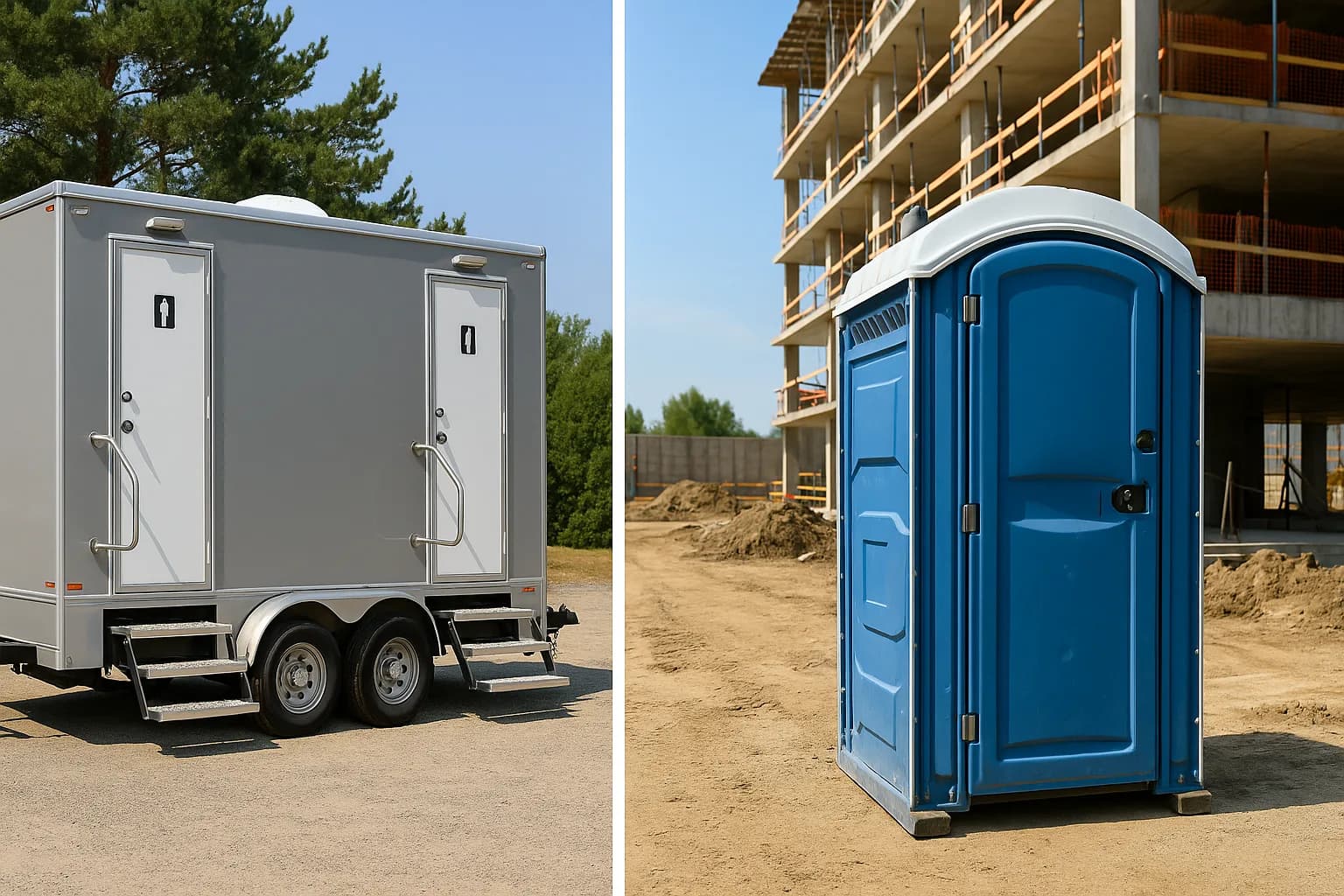
Standard units cover the large majority of Tucson construction work. A restroom trailer — a towable unit with flushing toilets, running water, sinks, and interior lighting — is a fit for a narrower set of situations: a long commercial project with on-site office staff, a high-end custom home builder who wants a better experience for the crew and clients visiting the site, or a temporary-facility need when a building's own restrooms are offline during a renovation. Trailers need a power source (a standard outlet or a generator) and a water connection or a fresh-water holding tank, so plan those before delivery.
For the trailer side specifically, Old Pueblo Restroom Trailers is a PTF featured restroom trailer provider serving Tucson and Southern Arizona; contact the provider directly to confirm what they can supply for a jobsite or temporary-facility use. For standard construction porta potties and hand wash stations, request quotes below. See the broad Tucson restroom trailer guide for trailer types, sizing, and planning detail.
Long-Term Rentals & Weekly Service Planning
Weekly service is the standard for Tucson construction sites — the visit pumps the holding tank, restocks supplies, and cleans the interior.
Small residential crew (1–5 workers)
Weekly service is typically enough. For short projects under about four weeks, confirm whether the provider has a minimum rental or service commitment.
Active crew (6–20 workers)
Weekly service with standard treatment. From roughly May through September, twice-weekly service keeps a heavily-used unit manageable in the heat.
Outlying or rural Southern Arizona site
Weekly service is still standard, but the delivery and service day may be less flexible on a long route — confirm the schedule and any distance fee up front.
Long-term or multi-phase project
Subdivision and phased commercial work benefit from a contract that lets you add or drop units as the project moves from site prep through finish, ideally with a locked-in service slot.
Corridor utility or road work
Ask about relocation service so units can follow the crew along the corridor rather than being picked up and re-delivered each phase.
Placement, Delivery & Service-Truck Access
In-town Tucson sites
Infill, subdivision, and commercial sites inside the metro are usually straightforward — an open staging area and a passable access road make weekly delivery and service routine.
Foothills and large-lot custom home sites
Catalina Foothills, Tanque Verde, and Corona de Tucson sites often have steep grading, a long private drive, or a gate. Share the access details so the provider can plan the delivery vehicle and route.
Dry lots and unpaved sites
New subdivision parcels before roads go in, and rural sites generally, are loose dirt. Keep the path to the unit graded and clear so a service truck can reach it, and expect it to get dusty enough to need attention between visits.
Corridor utility and road work
Units on a moving jobsite should be placed where they can be safely relocated as the work advances — coordinate relocation timing with the provider so the crew is never without a facility.
Placement relative to the crew and the public
Set units close enough that the crew actually uses them, but out of traffic lanes, clear of the equipment swing radius, and away from any public-facing frontage or neighboring property line.
Keep the unit reachable on service day
A unit boxed in by material deliveries or parked equipment can't be serviced — which is both a sanitation problem and a compliance one. Build a clear service lane into the site plan.
Desert Heat, Dust, Wind & Monsoon-Season Planning
Tucson's Sonoran Desert climate — long, hot summers, intense sun, blowing dust, and a distinct monsoon season — shapes how portable restrooms should be placed and serviced on local jobsites.
Summer heat and sun exposure
Daytime highs above 100°F are routine for months. Position units in available shade or so they avoid full afternoon sun where the site allows, and plan on more frequent servicing through the hottest stretch — heat works against a holding tank faster than crews expect.
Dust and dry-site conditions
Unpaved lots, site prep, and grading generate heavy dust. Keep the path to the unit clear and firm, and expect interiors and hand wash stations to need attention sooner than the weekly visit in peak dust conditions.
Monsoon-season wind
From roughly July through September, monsoon microbursts bring sudden strong wind. Ask the provider about staking or tie-downs and place units on stable, level ground with whatever windbreak the site offers.
Monsoon-season access
Brief, heavy downpours can leave unpaved access roads rutted or briefly impassable. On rural sites, confirm the provider's plan if a scheduled service day lands right after a storm.
Tucson & Southern Arizona Jobsite Planning Notes
Downtown and central Tucson infill
Tight infill and redevelopment sites near downtown and the University area have limited staging room. Plan unit placement early so it doesn't conflict with material laydown or street-frontage constraints, and expect the city permit to speak to sanitation on larger projects.
East and northwest Tucson growth areas
Subdivision and commercial work in the Marana, Oro Valley, and northwest-metro corridors, and in east Tucson toward Vail, runs on longer timelines — a flexible long-term contract with adjustable unit counts fits these better than a fixed short rental.
Catalina Foothills and Tanque Verde custom builds
Single-lot custom homes on difficult terrain are common here. The main planning factors are drive access, grading, and keeping a serviceable path to the unit through the length of a long build.
Sahuarita, Green Valley, and the southern corridor
Residential growth and site-development work south of Tucson sits at the far end of many providers' routes — confirm the service day and any distance fee, and consider a higher-capacity unit if weekly service isn't guaranteed.
Rural Southern Arizona and Cochise County work
Projects out toward Benson, Sierra Vista, and rural communities like Sonoita, Elgin, St. David, Willcox, Tombstone, and Nogales are well outside the metro. Delivery distance, self-sufficient unit capacity, and a realistic service interval are the things to pin down before the rental starts.
Unincorporated Pima County neighborhoods
Work in unincorporated areas like Casas Adobes and Flowing Wells follows the same OSHA baseline; there's no separate city permit process, but the county permit may still carry sanitation conditions on larger jobs. South Tucson is a separate incorporated city, so confirm permit conditions with its own local government. See the Casas Adobes page for more on that community specifically.
Cost Expectations
| Item | How It's Priced |
|---|---|
| Standard construction porta potty | Quoted per unit, per week |
| ADA-accessible unit | Usually priced above a standard unit |
| Deluxe / flushing unit | Usually priced above a standard unit |
| Hand wash station | Usually quoted as an add-on |
| Additional service visit (beyond weekly) | Quoted per extra visit |
| Outlying / rural Southern Arizona delivery | Varies — ask provider |
Tucson Construction Porta Potty Providers
Looking to connect with portable toilet providers serving Tucson and Southern Arizona construction sites? Request free quotes and we'll help match you with providers covering the metro and outlying Pima County job sites.
Get Free QuotesTucson & Southern Arizona Coverage
Construction porta potty needs come up across the greater Tucson metro and Southern Arizona — including in Casas Adobes and the separate incorporated city of South Tucson, both of which have their own location pages, in unincorporated Flowing Wells, and further out toward Sonoita, Elgin, Nogales, Tombstone, St. David, and Willcox, most of which don't have their own location pages yet. Confirm delivery coverage for your specific jobsite when requesting quotes.
Related Resources
Construction Porta Potty Rentals
The national guide to jobsite portable toilets — unit counts, servicing, and long-term rentals.
Arizona Construction Porta Potty Requirements
The statewide companion — OSHA planning, servicing, and Arizona jobsite conditions.
How Many Porta Potties Do I Need?
Crew-size formulas and OSHA unit counts for jobsites and events.
ADA Portable Toilet Rentals
When an accessible unit is required and what it includes.
Restroom Trailer Rentals in Tucson, AZ
The broad Tucson restroom trailer guide — event and construction uses, trailer types, and costs.
OSHA Porta Potty Requirements
Colorado-focused guide, but the federal 29 CFR 1926.51 rules it explains apply nationwide.
Porta Potty Rental Cost Factors
Colorado cost guide — the pricing-factor breakdown is a useful general planning reference.
Frequently Asked Questions
Need construction porta potty rentals in Tucson?
Get free quotes from providers serving Tucson contractors, builders, and long-term job sites across Pima County and Southern Arizona.